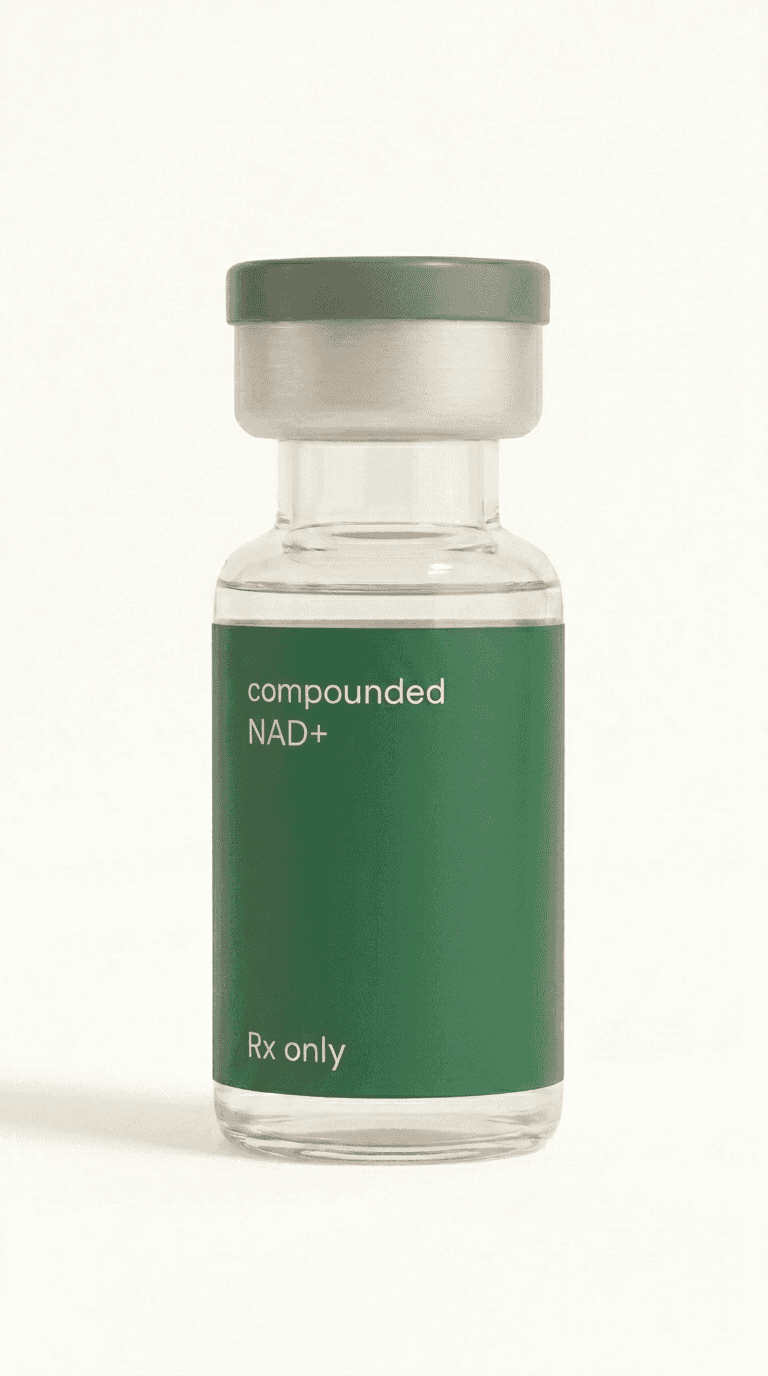
NAD+
Cellular Energy + Cognitive Support
- May help replenish a coenzyme that declines with age
- May support cellular energy (ATP) production at the mitochondrial level
- May support cognitive performance, focus, and mental clarity
- May activate pathways involved in DNA repair and cellular signaling
- May support healthy aging at the cellular level
- A frequent cornerstone of metabolic and longevity protocols
NAD+ (nicotinamide adenine dinucleotide) is a coenzyme present in every cell of the body, central to the chemistry of energy production, DNA repair, and cellular signaling. NAD+ levels decline meaningfully with age — and that decline tracks with the lower energy, slower recovery, and dimmer focus that often shows up in your 30s, 40s, and beyond.
Requires physician review and prescription approval
Common questions
What is NAD+?
NAD+ (nicotinamide adenine dinucleotide) is a coenzyme found in every cell of the body. It is essential to the metabolic reactions that produce cellular energy, and is also involved in DNA repair, gene expression, and the body's response to cellular stress.
How is it administered?
Subcutaneous injection, per a physician-determined protocol. Typical cycles run 4–12 weeks. Your provider will walk you through dosing, timing, and injection technique.
Who might consider NAD+?
Adults focused on cellular energy, cognitive performance, and longevity — particularly those experiencing the lower energy, slower recovery, or mental fog that often track with NAD+ decline. A prescribing provider would evaluate whether it's appropriate based on your medical history and goals.
Who should not use NAD+?
May not be appropriate for individuals who are pregnant or nursing, have active malignancy, or have certain chronic medical conditions. A prescribing provider would review your full medical history before recommending a protocol.
What are the potential side effects?
Generally well tolerated, with possible injection-site reactions, flushing, mild nausea, or headache during the initial cycle. Rare but more serious risks include allergic reactions. A prescribing provider would review benefits, risks, and monitoring requirements before starting.
How does NAD+ injection compare to NAD+ IV therapy or oral precursors?
Subcutaneous NAD+ offers a steady, lower-dose protocol that patients self-administer at home — different in pace and convenience than higher-dose IV infusions, which are typically given in-clinic over several hours. Oral precursors like NMN and NR are an indirect approach that the body converts to NAD+. A prescribing provider can help determine which delivery fits your goals.
Important information about compounded NAD+ therapy
If and when this therapy is available through Nuvara, compounded NAD+ for subcutaneous injection would be prepared by a licensed US compounding pharmacy based on an individual prescription, where permitted under FDA compounding rules. It is not an FDA-approved drug product and is not approved for any specific therapeutic indication. Use, formulation, and dosing are determined by a prescribing clinician based on individual evaluation.
Subcutaneous NAD+ is a different protocol than NAD+ IV infusion therapy or oral NAD+ precursors (NMN, NR). Each delivery method has its own pace, dose range, and convenience considerations. A prescribing provider can help determine which approach fits your goals.
NAD+ may not be appropriate for individuals who are pregnant or nursing, have active malignancy, or have certain chronic medical conditions. Common side effects during the initial cycle include flushing, nausea, mild headache, and injection-site reactions. Rare but more serious risks include allergic reactions. Any decisions about prescribing, dosing, informed consent, and ongoing monitoring would be made by the prescribing provider — not by Nuvara.
Interested in cellular vitality?
Share your goals, and we'll be in touch when Nuvara early access opens in your area.
Join Waitlist to Claim $100 Credit →